
An AC that’s running but blowing warm or hot air is one of the most common complaints we hear from Twin Cities homeowners. The good news: about half the time, the fix is something you can handle in a few minutes without a service call. The other half usually points to a refrigerant, airflow, or component issue that needs a licensed technician. Here are the six most common causes, what to check yourself, and when to call a pro.
Issue 1: The Thermostat Is Set to the Wrong Mode or Temperature
Before assuming the worst, walk over to your thermostat and check the settings. If the system is set to “Heat” or “Off,” the AC won’t cool, and the fan may blow neutral or warm air depending on what’s running. Here’s a quick checklist to work through:
- Make sure the mode is set to “Cool”
- Set the fan to “Auto” rather than “On”
- Check that the setpoint is lower than the current room temperature
- Replace the batteries if the display is blank
If the fan is set to “On” instead of “Auto,” the blower runs nonstop even when the compressor isn’t cooling, which can make it feel like the vents are pushing warm air. Switching to “Auto” usually fixes that immediately. If the settings look correct and the system still isn’t cooling, the cause is likely one of the issues below.
Issue 2: Dirty or Clogged Air Filter
A dirty filter restricts airflow across the evaporator coil. If the system can’t pull enough air across the coil to cool it efficiently, the air coming out of the vents feels lukewarm instead of cold. In severe cases, the coil can freeze over, causing the system to stop cooling entirely.
Pull the filter and hold it up to a light. If you can’t see light through it, replace it. Most filters need to be changed every 1 to 3 months during peak cooling season, and more often if you have pets or run the system heavily. Run the AC for an hour with a fresh filter and see if it starts cooling normally again.
Issue 3: Low or Leaking Refrigerant
Refrigerant is what your AC uses to move heat out of the home. When the charge is low, almost always because of a slow leak, the system can’t pull heat from the air, and the vents start blowing room-temperature or warm air instead of cold. Watch for these warning signs:
- Neutral or warm air from the vents
- Ice or frost forming on the copper refrigerant line at the outdoor unit
- A hissing or bubbling sound near the AC
- A steady climb in your electric bills
Refrigerant is federally regulated and must be handled by a licensed technician. Continuing to run an AC with low refrigerant can damage the compressor. Schedule AC repair right away if you see ice or hear hissing.
Issue 4: Frozen Evaporator Coil
The evaporator coil, located on top of the furnace, is where the AC absorbs heat from your home. If airflow drops too low due to a dirty filter, closed vents, or a dirty blower wheel, or if refrigerant runs low, condensation on the coil can freeze. Once it’s frozen, the coil can’t absorb heat and the vents start blowing warm or room-temperature air, even though the system sounds like it’s running normally.
You can check by opening the access panel near your furnace. Look for visible ice or frost on the copper refrigerant lines or directly on the coil. You may also see water dripping from the indoor unit as ice starts to melt. Switch the thermostat to “Off,” set the fan to “On,” and let the coil thaw for 4 to 24 hours.
While it’s thawing, replace the air filter. If the system’s still blowing warm air and the coil refreezes, call a technician. Recurring freezes usually point to a refrigerant problem.
Issue 5: Dirty or Blocked Condenser Unit
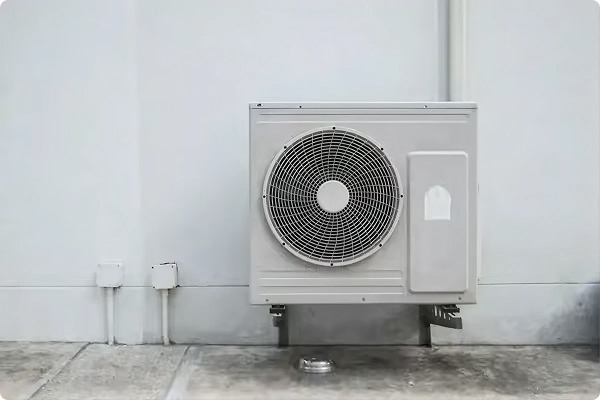
The condenser is the outdoor unit responsible for releasing heat from the refrigerant back into the outside air. When it’s covered in grass clippings, leaves, cottonwood fluff, or yard debris, or when shrubs have grown too close, the unit can’t disperse heat efficiently. The result is an AC that runs but blows warm air.
Take a look outside at the condenser. The metal fins around the outside should be clean and unobstructed. Clear away any clippings, leaves, or pet hair stuck to the fins, and trim any shrubs or grass back at least two feet on every side. Gently rinse the outside of the fins with a garden hose. Avoid pressure washers, which can bend the fins and reduce airflow.
After clearing the area and cleaning the fins, run your AC for about 30 minutes to see whether the temperature has improved. If it hasn’t, it’s best to call a technician.
Issue 6: Ductwork Leaks
Even when the AC is working properly, leaky or disconnected ductwork can rob your home of cold air before it ever reaches the vents. Faulty ducts let cool air escape into attics, crawl spaces, or basements, while warmer air from those unconditioned spaces gets pulled back into the return side.
To check for leaky ducts, use a flashlight to inspect any accessible ductwork in the basement, attic, or crawl space, looking for gaps at seams, sections that have pulled apart, hanging insulation, or crushed flex ducts. Tape up small gaps with foil HVAC tape, not standard duct tape. For anything bigger, schedule a duct assessment with a licensed technician.
Frequently Asked Questions
Why is my AC blowing hot air all of a sudden?
Sudden warm air usually points to a refrigerant leak, frozen evaporator coil, or thermostat issue. Check the thermostat mode, replace the filter, and look for ice on the indoor coil or outdoor refrigerant line.
Can a dirty filter cause my vents to blow hot air?
Yes. A clogged filter restricts airflow enough to weaken cooling and, in severe cases, freeze the evaporator coil. Replacing the filter is the cheapest, fastest fix to try first.
How long does it take to thaw a frozen AC coil?
Most frozen coils thaw in 4 to 24 hours with the thermostat off and the fan set to “On.” Heavy ice buildup can take a full day. Don’t try to chip the ice off, as it can damage the coil fins.
Will my AC damage itself if I keep running it?
Yes. Running an AC with low refrigerant, a frozen coil, or a blocked condenser stresses the compressor and shortens the system’s life. Shut the system off as soon as you notice warm air and check the basics before restarting.
Ready to Get Your AC Cooling Again?
If you’ve checked the thermostat, the filter, and the condenser, and the AC is still blowing warm air, it’s time to bring in a licensed technician. Hero handles diagnostics, refrigerant work, duct repairs, and full system service across the Twin Cities. Call or text us today and we’ll get a licensed technician to your home.