
An AC that won’t shut off makes your home uncomfortably cold, drives up your energy bills, and puts unnecessary wear on the equipment. Two of the most common causes have 30-second fixes you can handle yourself. The others usually need a licensed technician. Here are the six most common reasons a Twin Cities AC runs nonstop and when to call a pro.
Reason 1: Your Thermostat Fan Is Set to “On” Instead of “Auto”
This is the single most common cause of an AC that seems like it won’t turn off, and it’s not really a problem with the AC at all. Most thermostats have two fan settings: “On” and “Auto.” “Auto” runs the blower fan only when the system is actively cooling. “On” runs the blower 24/7, even when the compressor is off. If the fan is set to “On,” you’ll hear air moving through the vents constantly, but the air won’t always feel cold.
The telltale sign is neutral or slightly warm air at the vents while the fan runs, accompanied by silence from the outdoor unit. That means the blower is circulating air, but the compressor isn’t running because your home has already reached the temperature you set.
The fix is simple. Switch the fan from “On” to “Auto.” That’s it. No service call needed. If the air from the vents goes back to feeling cold only when the system is actively cooling, the fan setting was the culprit all along.
Reason 2: A Dirty or Clogged Air Filter
A dirty air filter restricts airflow across the indoor coil. The system can’t move enough cool air through the home, so it runs longer (sometimes constantly) trying to reach the thermostat setpoint. A heavily clogged filter can also freeze the evaporator coil, which makes the problem worse. This is one of the most common service calls we get, and it often turns out to be a five-minute fix. Scheduled filter changes and regular AC maintenance keep airflow steady.
Symptoms include weak airflow at the vents, an AC that runs nonstop without cooling your home, ice or frost visible on the refrigerant lines, and higher electric bills. The filter itself often looks gray or black when held up to a light.
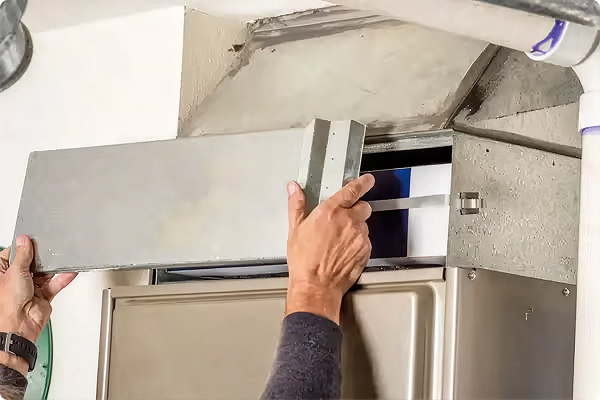
To fix the problem, locate your filter (usually in a return grille or right at the furnace cabinet), pull it out, and inspect it. If you can’t see light through it, replace it. Most homes need a new filter every 1 to 3 months during the cooling season. Run the system for an hour with the new filter installed before assuming the problem is something more complex.
Reason 3: A Broken or Miscalibrated Thermostat
If your thermostat thinks the room is warmer than it actually is, it will keep telling the AC to run even after the home is cool. Broken sensors, dead batteries, dust inside the housing, or a thermostat installed in a poor location (above a heat-producing appliance, in direct sun, or near a return vent) can throw off the temperature reading and make the system run continuously.
Symptoms: The thermostat displays a temperature that doesn’t match what a separate room thermometer displays, the display flickers or shows error codes, or the system runs even when the home feels cool.
DIY checks: Replace the batteries first. Then use a separate thermometer to compare the room temperature against the thermostat reading. If the gap is more than a couple of degrees, the sensor is off. Smart thermostats sometimes need a power cycle. To do this, pull the thermostat off the wall, wait 30 seconds, and push it back into place. If the thermostat is in a bad spot, that’s a wiring and relocation job for a technician. Call a pro if batteries and recalibration don’t fix it.
Reason 4: Low Refrigerant or a Refrigerant Leak
Refrigerant is what your AC uses to move heat out of the home. If the system is leaking refrigerant, it loses cooling capacity. When this happens, the AC keeps running because it can’t reach the setpoint, but the air from the vents gets warmer and warmer over the course of the day.
Symptoms: Warm or room-temperature air from the vents, ice or frost on the copper refrigerant line at the outdoor unit, a hissing or bubbling sound near the AC, a system that runs nonstop, and noticeably higher electric bills. In severe cases, the outdoor unit may freeze over entirely.
If you suspect a refrigerant leak, here’s what you can check yourself: Walk outside and look at the larger insulated refrigerant line at the condenser. If you see frost or ice, shut the system off and let it thaw completely before restarting it. Once it’s thawed, if the problem comes back, that’s a strong sign that there’s a refrigerant leak and it’s time to call a licensed technician. Refrigerant is regulated by the EPA and must be handled by a professional. If you suspect a leak, schedule AC repair right away. Continuing to run a low-refrigerant system can damage the compressor.
Reason 5: Leaky or Disconnected Ductwork
Cool air that leaks into an attic, crawl space, or basement before it reaches the rooms you live in forces the AC to run longer to keep up. Ductwork can develop gaps at the seams, lose insulation, get crushed by storage stacked on top, or pull apart at joints over time. In older Twin Cities homes, it’s common to find ducts that have come loose at a 90-degree elbow or have lost their outer wrap entirely.
Symptoms: Rooms farthest from the air handler stay warm, the basement or attic feels unusually cool, dust accumulates in the home faster than normal, and energy bills climb without a clear cause.
With the AC running, take a flashlight into your basement, attic, or crawl space and inspect every accessible run of ductwork. Look for gaps at seams, sections that have pulled apart, hanging insulation, crushed flex ducts, and rusty or torn metal. Hold your hand near any joint to feel for escaping cool air. Small gaps can be temporarily sealed with foil HVAC tape but avoid standard duct tape since it doesn’t hold up to heat and cold. For gaps or damage that go beyond what foil tape can handle, schedule a duct assessment with a licensed technician.
Reason 6: A Wrong-Sized AC System
While an undersized AC may run nonstop, an oversized unit will short-cycle, causing a different set of problems. An undersized AC is too small to keep up with the home’s cooling load on hot days, so it runs constantly without ever reaching the temperature you set. An oversized AC cools the air quickly but doesn’t run long enough to pull humidity out, leaving the home feeling cool but clammy and never quite comfortable.
You may have an undersized system that struggles to drop below 75 degrees on hot days, runs nonstop when temperatures climb above 90, but keeps up fine on milder days. Or you may have an oversized system that cycles on and off rapidly, sometimes every 5 to 10 minutes, while humidity stays high and certain rooms never feel right.
The fix depends on which of these problems you have. An undersized system needs a properly sized replacement. An oversized system can sometimes be improved with zoning controls, but replacing it with a system that’s the correct size is usually the most reliable way to solve the humidity problem for good. Either way, a licensed technician needs to run a detailed load calculation (known in the industry as a Manual J) which measures your home’s square footage, insulation, windows, sun exposure, and air leakage to determine the right system size for your home.
Frequently Asked Questions
How long should an AC run at a time?
On a mild day, an AC typically runs 15 to 20 minutes per cycle, several times an hour. On a 90+ degree day, the system may run for an hour or more at a time, which is normal. If your AC is running nonstop on a mild day, one of the six reasons above is likely the cause.
Will running my AC nonstop damage it?
Running your AC nonstop wears out the compressor and motors faster than normal. In the short term, you’ll experience higher bills and potentially frozen coils. Long term, you’ll shorten the system’s life. Catch and fix the cause as soon as you notice it.
Can a smart thermostat cause my AC to run nonstop?
Yes. A miscalibrated sensor, a misconfigured schedule, or a stuck fan setting can all keep the system running longer than it should. Check that the fan is set to “Auto,” review your cooling schedule to make sure it looks right, and confirm that any geofencing or away modes are functioning as expected.
Why is my AC running but not cooling?
The most common causes are a dirty filter, low refrigerant, a frozen coil, leaky ducts, or a failing compressor. Start by replacing the filter and checking the outdoor unit for ice. If neither of those solves it, call a licensed technician to diagnose the issue.
Should I turn off my AC if it won’t shut off?
Yes, if you see ice on the refrigerant lines or the system has been running nonstop in mild weather, shut it off. This gives the coil a chance to thaw and prevents further damage to the compressor. Once it’s off, work through the checks above or call a licensed technician if you’re not sure what’s causing it.
Still Running Nonstop? It’s Time to Call a Pro.
If you’ve checked the thermostat, replaced the filter, and the AC is still running nonstop, it’s time to bring in a licensed technician. Hero handles diagnostics, refrigerant work, duct repairs, and full system replacements across the Twin Cities. Call or text us and we’ll get an expert to your home right away.